Bottle Feeding A Goat Kid
One part of the farm I love the most is the dairy side. I’ve shared our farm in videos, on social media, and even here on the blog (check out my farmhouse milking porch and DIY goat milking stand!). Besides the garden, it’s my favorite aspect of what we do.
Almost all of my family has issues with milk, with the only real relief coming from raw milk specifically for my son and I. Having a way to consume dairy without being sick is something I get plain excited about. That desire is what led us to dairy goats in the first place.
We started with Nigerian Dwarf goats, kidded for two seasons, and milked for both before selling our original herd and purchasing a Nubian doe. My sweet Daisy is old enough to breed now, and I am absolutely tickled.
Which brings us to this little fellow!
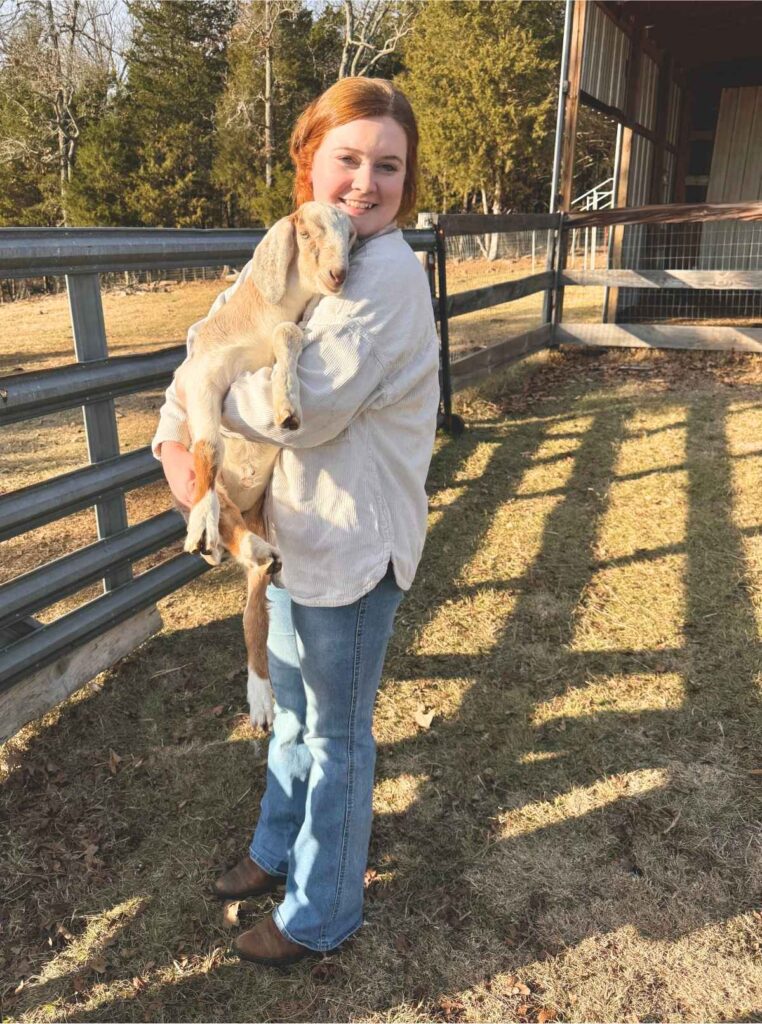
Sweet Sunflower
Meet our sweet boy, Sunflower. Isn’t he sweet? Originally we named him Sweet William but Ila Dawn kept calling him her sweet sunflower and it just stuck. We clearly love flower names around here.
She has taken on the role of feeding him quite a bit and it is the cutes thing! If you want to see something cute of your babies, just get them a goat. She pets them, tells them how beautiful they are and cuddles them like her own little baby.
Why We Brought Home a Nubian Buckling
I have been itching for floppy-eared Nubian babies on this farm, and when the opportunity came to bring home a Nubian buckling, we took it.
Just a couple days before Christmas, on a whim, I decided to look through a few Facebook groups I am in for a buck for our Nubian doe. I knew I wanted to grow our Nubian herd eventually, but that day it all came together quickly. A couple hours later, we went and picked up this cute little bottle baby and brought him home.
We’ve been feeding him three to four times a day ever since, and he is the sweetest little thing. Hopefully, before too long, we’ll be on our way to growing our Nubian herd and be back in milk again.
Bringing Him Home
He came to us at five weeks old as a bottle baby. I’ll admit, I was a little nervous at first. Having spent his first five weeks of life on his mama, I worried he might refuse a bottle altogether. But to my relief, he jumped right in and took to it just beautifully.
When we brought him home, we put him in a back stall where he could still be around Daisy but acclimate slowly. This also allowed me to bottle feed him properly without added stress.
We made it home late in the afternoon and he didn’t take much of a bottle that first evening, which didn’t surprise me. He was scared, stressed and probably had nursed all day. By the next morning, after spending the night in the barn and getting good and hungry, he latched right onto the bottle and hasn’t had trouble since. Praise the Lord!
Bottle Feeding a Goat Kid (The Way We Do It)
I’ll start by saying this- bottle feeding a goat kid doesn’t have to be complicated, I’ve learned. Folks like to make it sound like you need many different powders, a strict schedule, and endless hours with the baby to feed. It can be overwhelming! There are charts and schedules all over the internet that are helpful, I’m even including one here. While these make it simple, there is a degree of variance and working from intuition. Many times the amount of milk on the chart, he didn’t want. I didn’t force him to eat if he wasn’t hungry. And there were days he wanted a little more, so I gave him just a bit more making sure to keep an eye on the sides of his belly. Just keep it simple.
With this particular goat, we were just figuring things out so what I did is not necessarily what I would do next time. I’m going to share both with ya-what we did this time, what worked, and my farm notes of what I’d like to remember or do differently if we ever have another bottle baby, while it’s still fresh on my mind.
Do What Works For You
The ideal solution would be to feed goat milk from one of our doe’s but this was a start up solution on the farm, and not something we plan to do much unless we have to. We generally dam raise and wean boys around 8 weeks and girls closer to 12 weeks. But in the event that we have a doe reject a baby or have other reasons we need to bottle feed, I’d like to be prepared. So with that said, I don’t think I’d normally pull a baby just to bottle feed considering both the pros and cons, just simply based on our goals and values. But I know lots of people who do and that’s alright too!
What We Feed
The best option is always mother’s colostrum and milk. In our situation, this wasn’t possible as we bought the buckling.
The next best option is fresh goats milk and colostrum. Again, not an option for us while we swap breeds but if we ever have a doe reject a kid or for whatever reason need to bottle feed while we are in milk, this is what we will do.
A third option is fresh cows milk or even whole milk from the store and cow colostrum. This is what we are doing for this little buckling and he has had no issues. However, we did not do this with colostrum because he was with his mama on day one.
Last, there are powder replacers for both colostrum and milk. I would use this as a last resort. We have used replacers for an angus cow with success but I have not with a goat kid.
Always warm whichever option to 100-103 degrees Farenheit.
Along with bottles, we always keep fresh hay and water for any baby from birth, and like to keep babies that are seperated from the herd still within view and contact of the others so as not to limit their learning abilities while still keeping them safe. At 2 weeks, we start offering grain but usually they start sniffing at it sooner if they are with their mama and watching her.
How Much We Feed
While not as straight forward as the various charts online, the safest and simplest way to go about bottle feeding is based on the goats weight in ounces at each week.
Feeding Sunflower
Right now, we are feeding 16 ounces of whole cow’s milk, three to four times a day. Since this is my first bottle baby, I had no clue what I was doing. Cue reading 100 posts in various Facebook groups, 25 online blog articles and a book for research. There are several charts floating around but they vary widely in what is recomended. Due to the overwhelm, we just started feeding the baby 16 oz bottles when he would take them. Since he came to us at 5 weeks, we were past the scarier part of feeding and we just had to figure out how to get him to take a bottle. So I just fed him if he’d eat. Now we feed a 16 oz bottle 3-4 times a day. I have not weighed him and he’s doing alright. Belly is round but not tight and many times he will only drink 1/2 of the 4th bottle if it is offered so I am not worried.
Bottle Feeding Notes
HOWEVER- If I was to do this again, especially earlier on with a younger kid, here is what I’d do:
I would feed based on the weight of the goat in ounces. A minimum of 10% (sick or weak kid) but ideally 20% (healthy kid) of the goats weight in ounces per 24 hours. If I had a sick or weak kid, I’d work up to 20% from whatever they could eat which is hopefully at least 10% of their weight in ounces.
So if baby weighed 5 lbs:
5 lbs x 16 oz in a pound = 80 ounce goat
80 oz x .20 = 16 oz per 24 hours
Then I’d take the total ounces per 24 hours and spread that across how many bottles for the day.
Goat Kid Bottle Feeding Schedule
Typing myself up a schedule just to make it that much simpler. Hopefully it helps you too!
DAY 1
12 feedings of COLOSTRUM total, about every 2 hours.
Goat’s weight in lbs x 16 ounces per pound = goat’s weight in ounces
Goats weight in ounces x .10 (or up to .20) = total ounces per 24 hours
Total ounces per 24 hours / 12 feedings = ounces per bottle
Feed ounces per bottle, 12 times in the first 24 hours roughly 2 hours apart.
WEEK 1
6 feedings of MILK per 24 hours. Morning, mid-morning, lunchtime, early afternoon, late afternoon, evening.
Goat’s weight in lbs x 16 ounces per pound = goat’s weight in ounces
Goats weight in ounces x .15 (or up to .20) = total ounces per 24 hours
Total ounces per 24 hours / 6 feedings = ounces per bottle
Feed ounces per bottle, 6 times per day.
WEEKS 2-4
4 feedings of MILK per 24 hours. Morning, mid-morning, afternoon, evening.
Goat’s weight in lbs x 16 ounces per pound = goat’s weight in ounces
Goats weight in ounces x .20 = total ounces per 24 hours
Total ounces per 24 hours / 4 feedings = ounces per bottle
Feed ounces per bottle, 4 times per day.
Introduce water, hay and grain.
WEEKS 5-8
3 feedings of MILK per 24 hours. Morning, lunch and evening.
Goat’s weight in lbs x 16 ounces per pound = goat’s weight in ounces
Goats weight in ounces x .20 = total ounces per 24 hours
Total ounces per 24 hours / 3 feedings = ounces per bottle
Feed ounces per bottle, 3 times per day.
Always offer hay and water, grain if you’d like.
WEEKS 9-12
Weeks 9-12 will be the weaning process and since technically you can wean at 8 weeks, I would use that total ounces per 24 hours to wean down from. This requires slowly decreasing the ounces in one feed a little every few days until down to 2 feedings/day. And then continuing on until down to 1 feed/day. And then lastly down until weaned fully by 12 weeks. This is best just calculated based on the goat rather than a set amount to decrease each day. The kid should be more heavily reliant on hay, water, minerals and possible grain at this stage so the variance of decreasing won’t be harmful if done gradually. Decrease roughly a feeding a week. This would decrease the lunch feeding by the end of week 9, morning or evening by the end of week 10 and the last feeding by the end of week 11/start of week 12.
Week 9- decrease the middle bottle over the week until down to only the morning and evening bottle.
Week 10- decrease either the morning or evening bottle over the week until down to only one bottle a day.
Week 11- decrease the last bottle over the week until weaned by the start of week 12.
What We Use To Feed
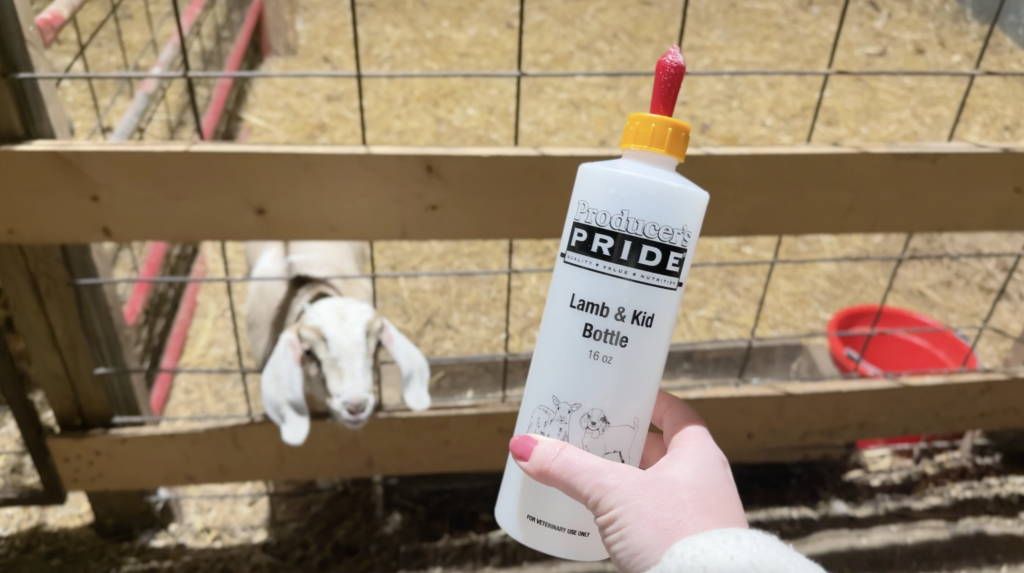
All we needed was some milk and a goat bottle. I have the Producer’s Pride bottle but it is no different than this bottle. I have also seen others use a cheap baby bottle from Wal-Mart for really little kids!