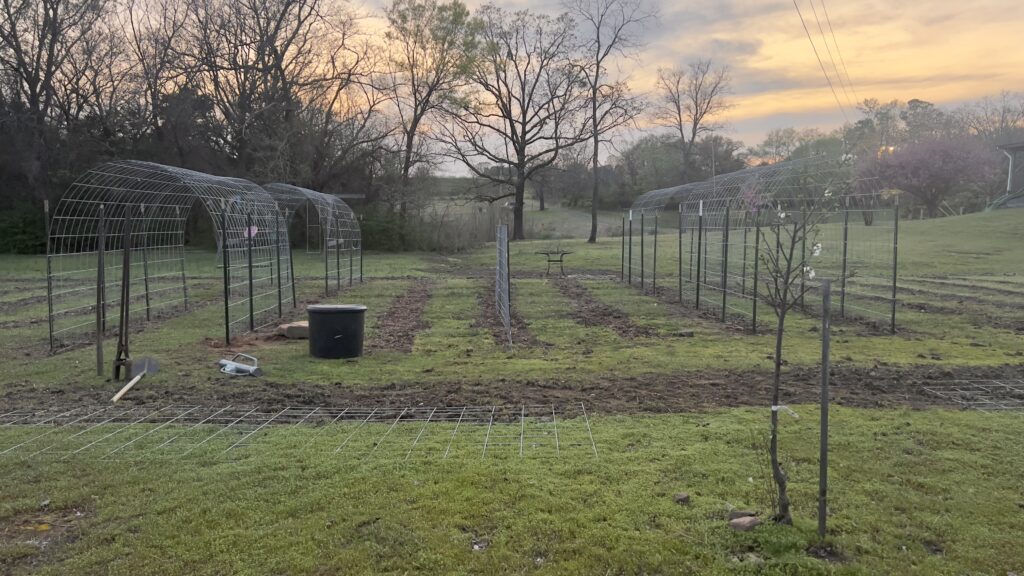
We have all of the trellises in that we plan to add this year, and I gotta say, they turned out even better than I imagined! There’s something so satisfying about seeing a garden come together piece by piece, especially when the bones of it are simple and practical and meant to last.
A Garden Meant to Be Simple
From the very beginning, I wanted this garden to be a simple one. Not overly frilly or decorative, but the kind of garden where the plants themselves hold the beauty. Evenly spaced rows, tidy walkways, and just enough structure to support what’s growing.
I’ve always loved the look of old-fashioned American gardens, the kind built first and foremost to grow food. Beauty came later, not from decoration, but from fullness and use. Flowers for beauty, corn standing at attention, cucumbers peeking through the vines and a basket of yellow squash filled to the brim.
Country Rows Over Cottage Curves
As I’ve mentioned before, I’m drawn to those old American farm gardens you might find way out in the middle of nowhere. Gardens with straight rows and a sense of order that makes the garden easy to tend.
No chaotic planting. No mixing everything together in varying heights. And only a touch of whimsy. A girl still needs a littel whimsy after all! My style in all things is usually clean and simple, very basic bones. Then a little frill on top just to be decorative. But I like timeless and easy to tend to bones.
Straight rows make for easier keeping, and clean lines draw the eye right to the plants themselves. I want to see rows of tomatoes, corn, and okra. Arches of cucumbers. Tall sunflowers. While cottage gardens are beautiful, there’s something about a classic, tidy garden that feels grounding and timeless to me.
Saving the Pretty for Another Season
We started this garden slowly. For the first few years, we simply tilled up this section of the property and planted more, quite frankly, than we could manage. After a few seasons, we added these cattle panel trellises along with a very unfinished fence. Just something good enough to keep the critters out.
To add a little charm, we installed two sets of double picket gates on each side. Adding a little each season has kept the garden from feeling overwhelming, both in workload and in cost.
While I love the classic style of this space, I do plan to add split rail fencing and wooden garden arbors in the future, all painted a bright white. Between those white touches and the beauty of the vegetables and flowers themselves, I hope the garden will eventually have that old-fashioned charm I’m always chasing.
A Warm Day and No Real Plan
Once we had a large stack of cattle panels, some for fencing and a few extra for trellises, I worked without a plan.
I knew I wanted a mix of vertical trellises and arches through the center, while leaving the side sections open for larger planting areas. My mom always tells me that things don’t always work on paper like they will in real life and while the garden isn’t really what she’s talking about, I find it fitting. I needed to just be out there and physically see my ideas come to life to make any further decisions. Drawing them out on paper just wasn’t cutting it. Any excuse to throw on a pretty sunhat and play outside for a bit!
Vertical Trellises
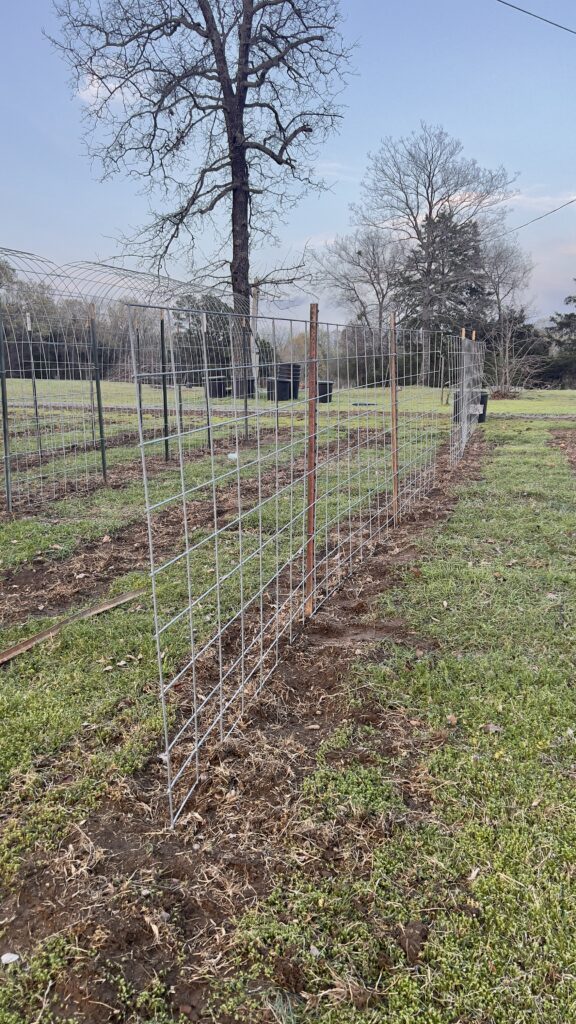
For the vertical trellises, I pictured plants that needed support but wouldn’t necessarily vine or get too terribly tall. Things like tomatoes and peppers. I also plan to grow summer squash vertically this year to help with squash bugs and improve airflow.
To build these, we spaced two cattle panels evenly along a row in the very center of the garden, leaving a walkway down the middle. We used two T-posts per panel and attached the panel along the 8-foot side so it was wider than it was tall.
Arched Trellises
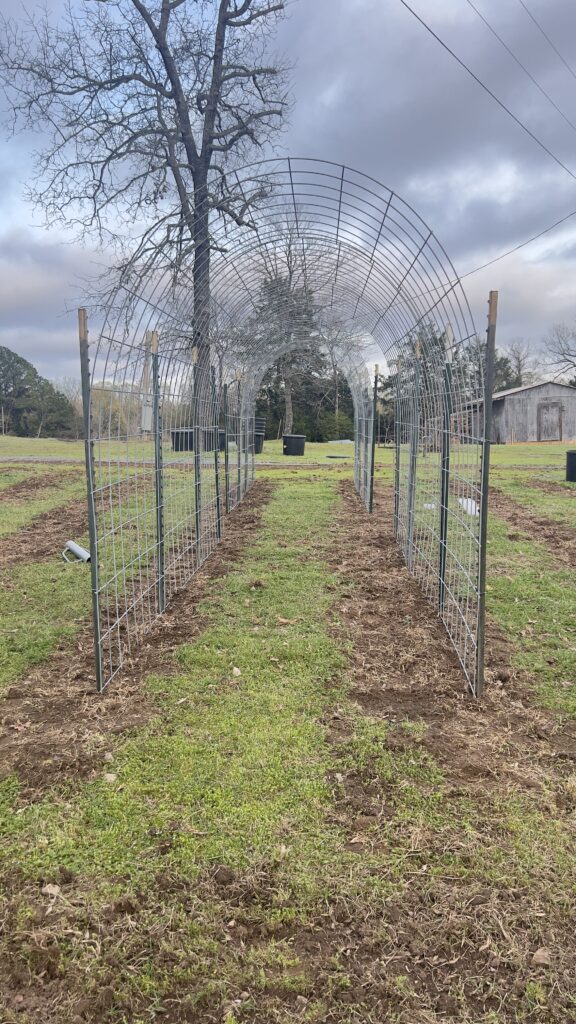
These are my favorite of the two styles. We built four arches, spaced evenly on each side of the vertical trellises. I imagine pumpkins, peas, green beans, cucumbers, and gourds climbing up and over them as the season goes on.
To build the arches, we started them at the ends of the vertical trellises. Each arch uses three cattle panels. We placed a T-post across the end, laid the short side of the panel against it, and positioned the next post. Then we walked the panel up into an arch, tied it to the posts, and drove two more posts on the opposite side to secure it.
We repeated this process three times, overlapping each panel with the previous one so they could share posts. In total, we used just three cattle panels and eight T-posts for each arched section.
As the season unfolds, these cattle panel trellises will, Lord willing, disappear a bit beneath leaves and vines, which is just how I like it. They aren’t meant to steal the show. They’re simply there to hold things up, guide growth, and make the work of gardening a little easier. That’s how I think a good country garden should be. Useful first with beauty added as time marches on. If you’re dreaming of a garden that feels timeless, manageable, and rooted in practicality, cattle panel trellises are a simple place to begin.

Leave a Reply